
Reading Levels
CEFR levels explained
The CEFR describes language ability on six levels, from A1 to C2. Here is what each level means for reading, based on the Council of Europe's own descriptions.
What you can read at each level
| Level | Stage | You can read |
|---|---|---|
| A1 | Beginner | Familiar names and words, and very simple sentences, like those on signs and in catalogues. |
| A2 | Beginner | Very short, simple texts: menus, timetables, adverts and short personal messages. |
| B1 | Intermediate | Texts in everyday language, and personal letters describing events, feelings and wishes. |
| B2 | Intermediate | Articles on current issues where the writer takes a position, and contemporary fiction. |
| C1 | Advanced | Long, complex factual and literary texts, specialised articles and technical instructions. |
| C2 | Advanced | Almost any written language with ease, including abstract and structurally complex texts. |
Word counts and study hours
The CEFR does not set word counts or study hours. It describes what you can do with a language, and any number you see attached to a level is someone's estimate. Estimates differ between sources, and the time you need depends on the language and on what you already speak.
Other scales measure different things. Japanese has the JLPT and Chinese has the HSK, and neither maps exactly onto the CEFR. In Story Languages, Japanese kanji follow the JLPT bands and Chinese vocabulary follows the HSK 3.0 bands.
To find your reading level, try a text. If you are looking up a word in every line, drop a level. If you understand nearly everything and can guess the rest, you are in the right place.
Download Story Languages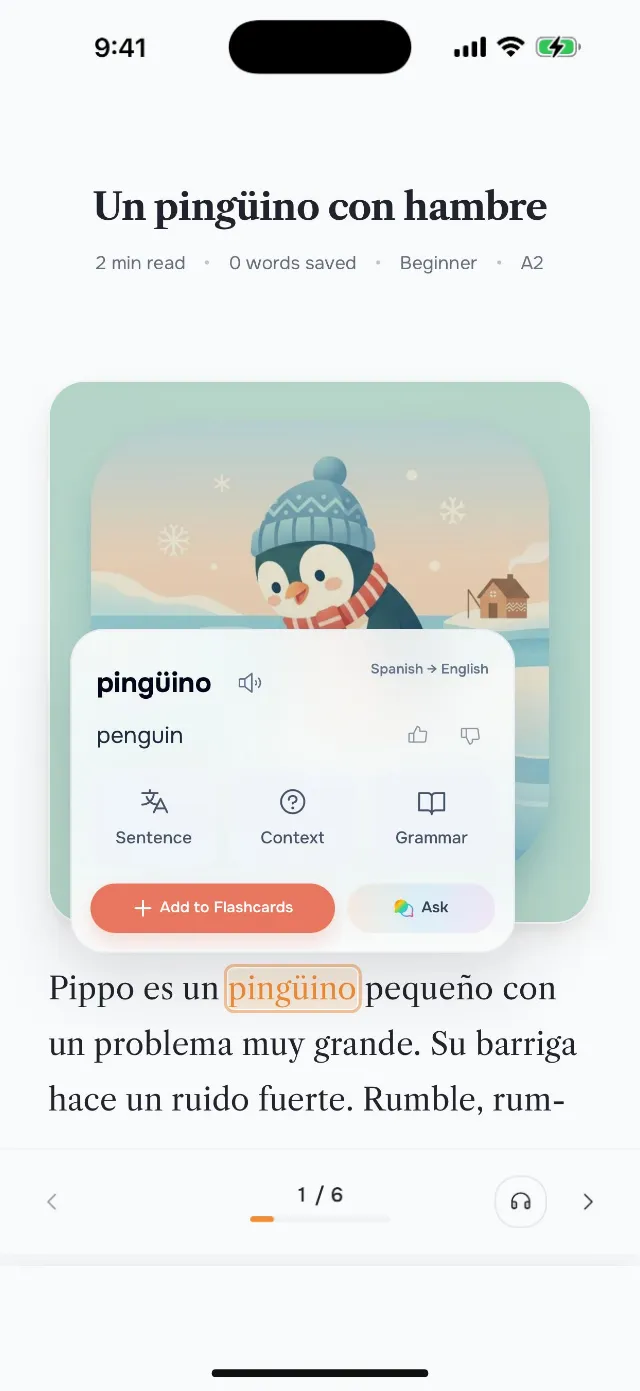
FAQ
What does CEFR stand for?
The Common European Framework of Reference for Languages. Published by the Council of Europe, it describes language ability on six levels from A1 to C2.
How many words do you need for each CEFR level?
The CEFR does not set word counts. It describes what you can do with a language. The figures you see online are estimates from schools and publishers, and they vary widely.
How long does it take to reach B2?
It depends on the language, on what you already speak and on how you study, and the CEFR does not set hours either. Treat any single number as a rough estimate.
Which level should I read at?
Pick text where you understand nearly every word. Hu and Nation (2000) estimated that readers need to know about 98% of the words in a fiction text to follow it without help. Later studies question the exact figure, so treat it as a guide.
Can I read stories graded by CEFR level?
Yes. Story Languages, an iPhone and iPad app, has graded stories in 12 languages labelled by CEFR level, with a translation for any word you tap.