Learn Chinese by Reading
Learn Chinese with stories
Read graded Chinese stories with pinyin over every character, from A1 to C1.
Learn Chinese (Mandarin, Simplified characters) through stories inside Story Languages. Graded stories from A1 to C1 carry pinyin with tone marks over every character, and the vocabulary at each level follows the HSK bands. Tap any word for a translation, save it to flashcards that keep the pinyin, and ask the AI tutor about grammar.
 On the App Store as Stories - Language Learning
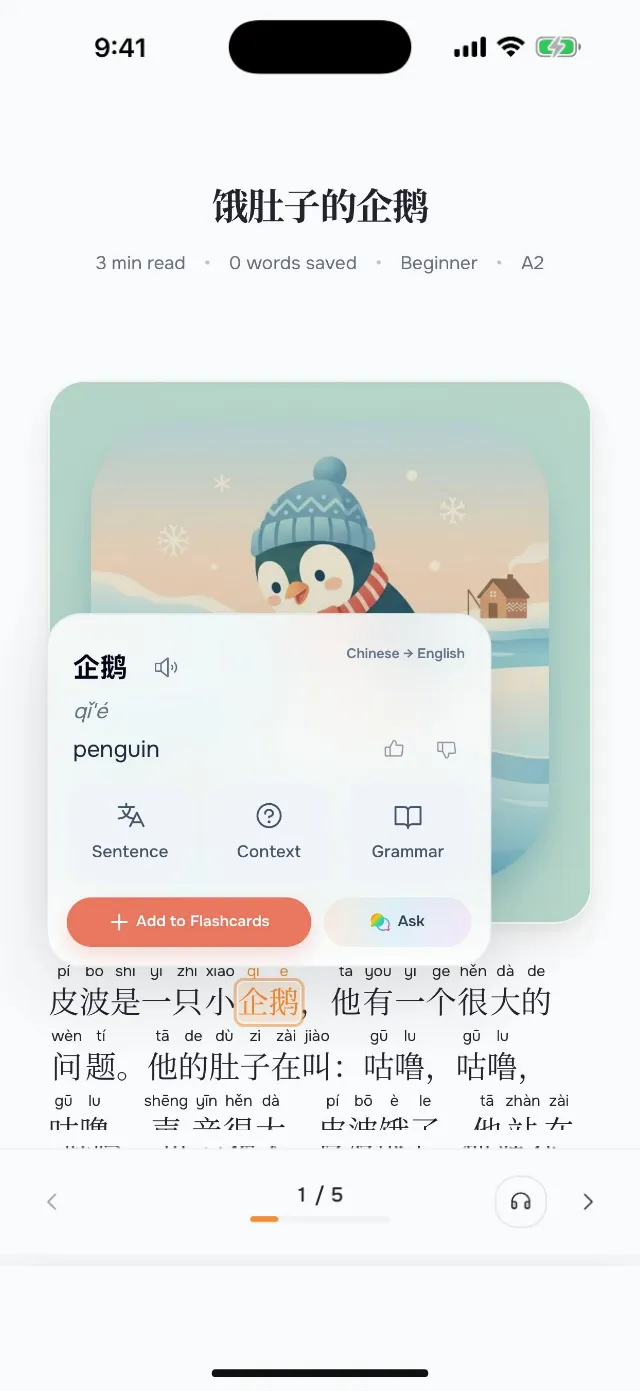
Read in context
Stories show characters again and again inside real words and sentences, which is how they stop looking like strokes and start reading as words.
Get grammar help
Ask the AI tutor about measure words, aspect particles like 了 and 过, or why a sentence uses 把 when the structure is unclear.
Hear the language
Listen to every story read aloud while the pinyin shows the tones, so each character is tied to its sound.
What makes Chinese hard to read, and how stories help
Pinyin over every character
From A1 to B1, each character carries its pinyin with tone marks by default, so you can read a story before you know the characters. Turn the pinyin off when you are ready, or keep it on at every level.
Four tones
Mandarin uses pitch to tell words apart: mā (mother) and mǎ (horse) differ only in tone. Seeing the tone mark while you hear the sentence read aloud is the quickest way to make tones stick.
No spaces between words
Chinese is written without spaces, so the first task is seeing where a word ends. A tap takes the whole word as a dictionary lists it, such as 学校 (school), and saves it in that form.
Measure words
Chinese puts a measure word between a number and a noun: 一本书 (one book), 一杯茶 (one cup of tea). Reading meets the common pairs so often that the right one starts to sound natural.
What to look for in an app to learn Chinese with stories
Graded Chinese stories that feel readable instead of overwhelming
Tap-to-translate support for unknown Chinese words in context
Flashcards built from the vocabulary you actually save
Audio, so you hear how written Chinese sounds
Fast grammar help when a Chinese sentence or structure is unclear
Reading Workflow
- 1
Open a Chinese story at your current level.
- 2
Tap unfamiliar words instead of breaking concentration with outside lookups.
- 3
Save the useful vocabulary that appears in real sentences.
- 4
Review those words later with spaced repetition.
FAQ: learning Chinese with stories
Where can I read graded Chinese stories with pinyin?
In Story Languages, an app for iPhone and iPad. Its Chinese stories run from A1 to C1, and pinyin with tone marks sits over every character, shown by default from A1 to B1.
Can I turn the pinyin off?
Yes. The reader's text settings show pinyin automatically for A1 to B1, always, or never, so you can wean yourself off it at your own pace.
Is it Mandarin with simplified or traditional characters?
Mandarin Chinese with Simplified characters, the standard used in mainland China and Singapore.
How are the Chinese stories graded?
Each level draws its vocabulary from the HSK 3.0 bands: A1 from band 1 up to C1 from bands 5 and 6. Grammar such as 把 and 被 arrives at B1, and four-character idioms at B2.
Do saved Chinese words keep their pinyin?
Yes. A word you save from a story becomes a flashcard with its pinyin on the back, so you can review the reading as well as the meaning.
How should a beginner start learning Chinese with stories?
Start with the easiest stories, tap the words you don't know and save the ones worth keeping. Review those flashcards for a few minutes a day, and move up a level when the stories start to feel easy.
Can I learn Chinese for free with Story Languages?
Story Languages is free to start. Premium opens every Chinese story and removes the limits.
Explore other languages
Start learning Chinese with stories
Read, save words, review them later, and keep moving through stories that make Chinese feel usable instead of abstract.