Learn Korean by Reading
Learn Korean with stories
Read graded Korean stories from A1 to C1, and learn Hangul on the way in.
Learn Korean through stories inside Story Languages. Graded Korean stories run from A1 to C1, a Hangul alphabet deck gets you reading in days, and a tapped word shows its romanization at the early levels. Tap any word for a translation, save it to flashcards, and ask the AI tutor about particles and verb endings.
 On the App Store as Stories - Language Learning
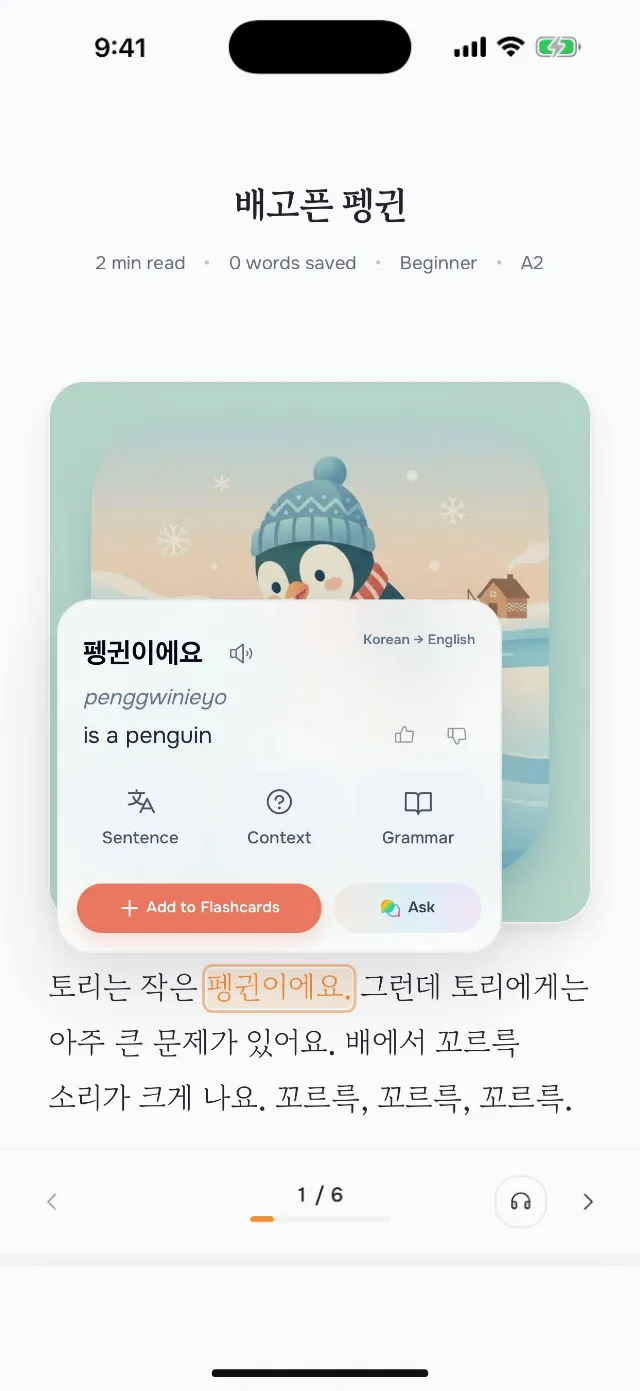
Read in context
Stories show Korean particles and endings attached to real words in real sentences, which makes them easier to recognize than tables do.
Get grammar help
Ask the AI tutor about particles like 은/는 and 이/가, verb endings, or speech levels when a sentence is unclear.
Hear the language
Listen to every story read aloud, and check a tapped word's romanization to see how Korean sound changes work.
What makes Korean hard to read, and how stories help
An alphabet you can learn in days
Hangul has 24 basic letters, 40 with the doubled consonants and combined vowels, grouped into syllable blocks: ㅎ, ㅏ and ㄴ make 한. The Hangul deck and its short primer teach every one with a sound, so the first story is within reach after a few sessions.
Particles stay on the word
Korean attaches particles to the noun, so 학교에서 is “at school” written as one word. A tap takes the word with its particle, and its translation covers both parts, as in “at school”.
Spelling and sound differ
Korean letters change sound next to each other: 학년 is said hangnyeon, not hak-nyeon. At A1 and A2, a tapped word shows its romanization with those sound changes, so you hear what you read.
Speech levels
Korean verbs change with who you are talking to. Our A1 and A2 stories use the polite 해요 style you hear every day, and the plain written style arrives from B1.
What to look for in an app to learn Korean with stories
Graded Korean stories that feel readable instead of overwhelming
Tap-to-translate support for unknown Korean words in context
Flashcards built from the vocabulary you actually save
Audio, so you hear how written Korean sounds
Fast grammar help when a Korean sentence or structure is unclear
Reading Workflow
- 1
Open a Korean story at your current level.
- 2
Tap unfamiliar words instead of breaking concentration with outside lookups.
- 3
Save the useful vocabulary that appears in real sentences.
- 4
Review those words later with spaced repetition.
FAQ: learning Korean with stories
Where can I read easy Korean stories at my level?
In Story Languages, an app for iPhone and iPad. Its Korean stories are graded from A1 to C1, with tap-to-translate, audio and flashcards built in.
Can I start if I can't read Hangul yet?
Yes. The app has a Hangul alphabet deck and a short primer on how the letters build syllables. Practice the letters, then open your first A1 story.
Is there romanization?
Yes, in the word popover. At A1 and A2 a tapped word shows its romanization, sound changes included. You can switch it to always or off in the reader's text settings.
Does Story Languages help with Korean grammar?
Yes. Ask the AI tutor why a sentence uses a particle or an ending, and it explains with the sentence in front of you.
How should a beginner start learning Korean with stories?
Start with the easiest stories, tap the words you don't know and save the ones worth keeping. Review those flashcards for a few minutes a day, and move up a level when the stories start to feel easy.
Can I learn Korean for free with Story Languages?
Story Languages is free to start. Premium opens every Korean story and removes the limits.
Explore other languages
Start learning Korean with stories
Read, save words, review them later, and keep moving through stories that make Korean feel usable instead of abstract.